
India has over 900 million internet users. Every single day, hundreds of millions of searches happen on Google.in — people looking for lawyers in Pune, restaurants in Bengaluru, CA firms in Indore, software companies in Hyderabad. The question is: when those searches happen, does your business show up?
If you're not on the first page of Google, you're invisible to 95% of those potential customers. SEO — Search Engine Optimization — is the discipline of making sure your website earns those top spots. But SEO in India is not the same as SEO in the US or UK. Indian search behaviour, regional languages, mobile-first infrastructure, and competitive dynamics require a tailored playbook.
This guide is that playbook. It covers every major dimension of SEO that Indian businesses need in 2026 — from technical foundations and keyword research to local SEO, AI tools, and programmatic content at scale. Each chapter links to a deeper dive so you can go as far as you need.
⚡ How to use this guide: Read the overview to understand the full SEO landscape, then click into the chapter most relevant to your current situation. If you'd rather have experts handle it, get a free SEO audit from the Click Decoded team.
Why Every Indian Business Needs an SEO Strategy in 2026
India is the world's fastest-growing digital economy. With Jio-driven internet penetration reaching tier-2 and tier-3 cities, the digital opportunity is no longer limited to metros. A bakery in Raipur, a CA firm in Nagpur, a real-estate developer in Surat — all compete on Google, and all can win with the right SEO strategy.
The shift in buying behaviour is irreversible. Before making almost any purchase — a product, a service, a doctor, a school — Indian consumers now Google it first. They read reviews, compare options, check websites, and call businesses they find at the top. If your competitor ranks above you for your key search terms, they're capturing customers who would have chosen you.
Beyond visibility, SEO delivers compounding returns that paid advertising cannot. A Google Ads campaign stops the moment your budget runs out. A well-ranked SEO page keeps driving qualified traffic month after month, year after year, with zero marginal cost per visitor. The ROI of SEO at 12–24 months consistently outperforms every other digital channel for Indian businesses with competitive intent.
The urgency in 2026 comes from Google's expanded AI search features — AI Overviews, AI Mode, and generative answers — which are reshaping the SERP. Businesses that built strong content and authority before these features rolled out in India are pulling further ahead. The window to establish organic authority before AI search becomes dominant is closing. Starting now matters more than it did even 18 months ago.
Keyword Research for Indian Markets: Finding What Your Customers Actually Search
Keyword research is the foundation of every effective SEO campaign. For Indian businesses, it's more complex than it looks — you're dealing with English searches, Hinglish searches, regional language searches, and entirely different intent patterns than Western markets.
The Three Layers of Indian Keyword Research
Primary keywords are high-volume head terms like "CA firm in India" or "web development company." These are competitive and important to target long-term. Secondary keywords are more specific, like "chartered accountant for startup registration Pune" — lower volume but higher purchase intent. Vernacular and Hinglish keywords — searches like "best CA near me" mixed with Hindi intent — are a massive opportunity that most businesses ignore entirely.
Tools That Work in India
Intent-First Keyword Mapping
Every keyword has an intent. Map each to the right page type before creating content — this is one of the most common and costly mistakes Indian businesses make.
💡 India-specific tip: Add city modifiers to your keyword research. "Divorce lawyer" has 90K monthly searches nationally, but "divorce lawyer Bhopal" has clearer commercial intent and far less competition. Start local and expand.
On-Page SEO: Optimising Every Page to Earn Rankings
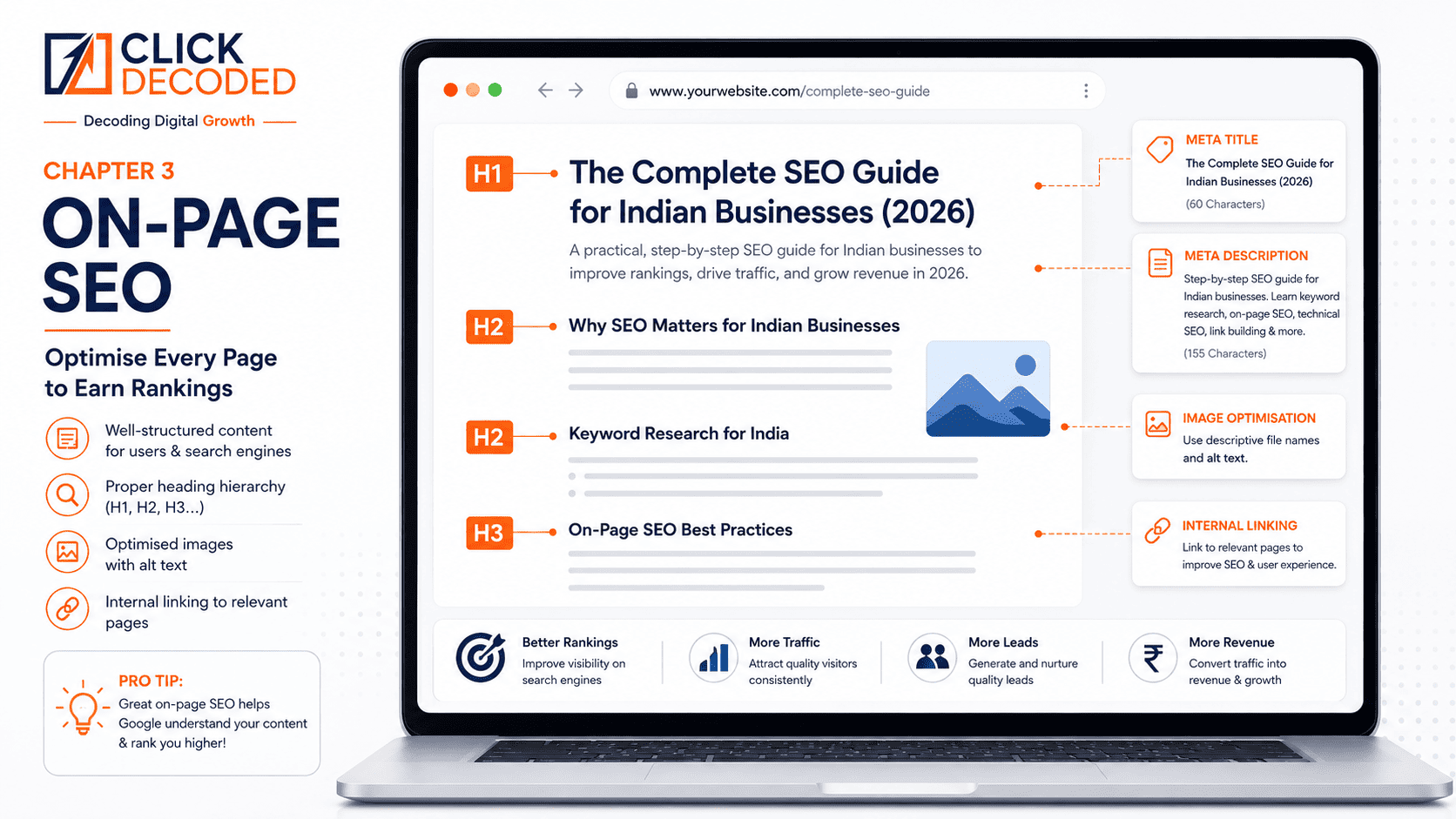
On-page SEO refers to everything you can control directly on your web page to help Google understand what it's about and serve it to the right searchers. It's not about stuffing keywords — it's about clarity, relevance, and delivering exactly what the user came looking for.
Title Tags and Meta Descriptions
Your title tag is the single most important on-page signal. It should contain your primary keyword naturally, be under 60 characters, and give a user a compelling reason to click. Don't just write "Home | Company Name" — write "GST Filing Services in India | Fast, Accurate & Affordable." Meta descriptions don't directly affect rankings but massively affect click-through rates, which do. Write them for humans, not crawlers.
Header Structure (H1–H3)
Every page should have exactly one H1 — the main topic. H2s break the page into major sections. H3s subdivide those sections. This structure signals semantic organisation to Google and makes content scannable for users. Indian business websites frequently have no H1 at all, or use H1 for design purposes rather than SEO.
Content Depth and E-E-A-T
Google's quality rater guidelines emphasise Experience, Expertise, Authoritativeness, and Trustworthiness (E-E-A-T). For Indian service businesses — lawyers, doctors, financial advisors, consultants — this means author bios, credentials, case studies, reviews, and trust signals on every page. Thin pages with 200 words don't rank for competitive terms. Comprehensive, expert-authored content does.
Internal Linking
Internal links distribute "link equity" across your site and help Google discover new pages. Every service page should link to related blog posts. Every blog post should link to the most relevant service page. The goal is to build a logical content web where every page supports every other page — not isolated silos.
Technical SEO for Indian Websites: The Foundation That Rankings Are Built On
Technical SEO is everything that happens below the surface of your content — the infrastructure that makes your site crawlable, indexable, fast, and secure. In India, technical SEO is often neglected, which is precisely why it represents such a big opportunity for businesses willing to get it right.
Crawlability and Indexation
Googlebot must be able to access and understand every page you want to rank. Common Indian website issues include blocked robots.txt files, broken redirects from old site migrations, duplicate content from URL parameters, and thousands of thin or auto-generated pages cannibalising rankings. A proper site audit reveals exactly what Google sees when it crawls your site — and often, the gap between what you think is indexed and what actually is surprises businesses dramatically.
Site Speed on Indian Networks
India's mobile network infrastructure, while improved massively since Jio, still means many users access your site on 4G connections in semi-urban areas. A site that loads in 2 seconds for a user in Bengaluru on fibre may take 6 seconds for a user in Jabalpur on 4G. Core Web Vitals — LCP (loading), INP (interactivity), and CLS (visual stability) — are direct ranking signals. Indian websites average an LCP of 4.2 seconds. Getting it under 2.5 seconds alone can move you significantly up the rankings.
HTTPS and Security
Every website in 2026 must be HTTPS. Google flagged non-HTTPS sites as "Not Secure" years ago, and modern users will not trust or convert on a site without the padlock. If your site still runs HTTP, this is your highest-priority fix.
Structured Data and Schema Markup
Schema markup tells Google explicitly what your content is — a business, a review, a product, an FAQ, a service. It unlocks rich results in the SERP — star ratings, FAQ dropdowns, price ranges — which dramatically increase click-through rates. Indian service businesses can implement LocalBusiness, Service, and Review schema to stand out from competitors who have none.
Local SEO for Indian Businesses: Dominating "Near Me" Searches in Your City
Local SEO is the practice of optimising your business to appear in location-based searches — "CA firm near me," "best restaurant in Indore," "web designer Bhopal." For most Indian service businesses, local search is the highest-value SEO channel because searchers are in buying mode right now, in your city, looking for exactly what you offer.
Google Business Profile (GBP) — Your Most Important Local Asset
Your Google Business Profile (formerly Google My Business) is the cornerstone of local SEO. A fully optimised GBP appears in the Local Pack — the map box with three businesses that appears above organic results for local searches. Getting into the Local Pack for your key service terms in your city can drive more calls, directions, and walk-ins than your entire website. Complete every field, add weekly posts, upload high-quality photos, and respond to every review — positive or negative — within 24 hours.
NAP Consistency Across India's Directories
NAP stands for Name, Address, Phone number. Google validates your local presence by checking that your NAP is consistent across directories like JustDial, Sulekha, IndiaMart, Practo, Zomato, and dozens of other Indian listing sites. Inconsistencies — slightly different phone numbers, old addresses, abbreviated names — confuse Google and suppress your local rankings. An NAP audit and citation cleanup is one of the fastest wins in Indian local SEO.
Local Content and Location Pages
If you serve multiple cities, create a dedicated, substantive page for each location — not thin, templated pages, but genuinely useful pages with local case studies, local testimonials, city-specific information, and embedded Google Maps. A well-built location page for "SEO services Bhopal" or "CA firm Indore" can rank in both local pack and organic results simultaneously.
Off-Page SEO & Link Building in India: Building Authority That Moves Rankings
Off-page SEO refers to signals outside your own website that tell Google your site deserves to rank — primarily backlinks. A backlink is when another website links to yours. In Google's algorithm, each high-quality link acts as a vote of confidence. The more authoritative and relevant the site giving you that vote, the more ranking power it transfers.
Why Links Still Matter in 2026
Despite multiple Google updates over the years, link authority remains one of the top-three ranking factors. Sites with strong backlink profiles consistently outperform technically perfect sites with weak link profiles in competitive niches. In India, where most businesses have very few quality backlinks, even a modest link-building campaign can produce dramatic ranking improvements.
Link Building Strategies That Work in India
Not all links are equal. This ladder shows link types ranked from foundation to elite — you need all four, but the higher you climb, the more your rankings move.
What to Avoid
Paid link schemes, private blog networks (PBNs), and link exchanges that violate Google's guidelines can result in manual penalties that erase your rankings overnight. With AI-enhanced spam detection in Google Search Essentials, manipulative link patterns are caught faster than ever. Focus on link quality and relevance, not volume.
Content Marketing & SEO: Creating Content That Ranks, Converts, and Builds Authority
Content is the engine of SEO. Every ranking you want requires a page — and every page needs content that serves the user's intent better than every competing page. For Indian businesses, content strategy is often the most underinvested dimension of SEO, which makes it one of the highest-leverage opportunities.
The Pillar-Cluster Content Architecture
The most effective content structure for SEO in 2026 is the pillar-cluster model. A pillar page covers a broad topic comprehensively (like this very guide). Cluster pages go deep on each sub-topic and link back to the pillar. This architecture signals topical authority to Google — that you know your subject inside and out — and creates a web of internal links that distributes ranking power efficiently across your site.
Writing for India's Search Intent
Indian searchers have some distinctive patterns. "Near me" searches are far more common than in Western markets. "Free" and "best" are extremely high-frequency intent modifiers. Comparison searches ("X vs Y") are growing rapidly, especially in software, banking, and insurance. Educational intent ("how to," "what is," "kya hai") drives enormous search volume in Tier 2 and Tier 3 cities as digital literacy expands. Your content calendar should map directly to these intent patterns.
Content Formats That Perform in India
Long-form guides and comprehensive how-to articles rank best for informational queries. Service pages with detailed descriptions, benefits, processes, and pricing signals rank for commercial intent. Case studies with specific, local client results build credibility and convert. FAQ pages with structured data appear in rich results and answer boxes. Video transcripts and embedded YouTube videos (hosted on your own channel) provide dual-channel SEO benefits.
Mobile SEO in India: Optimising for a Mobile-First Nation
India is the world's most mobile-first major internet market. Over 78% of all searches in India happen on mobile devices. Google uses mobile-first indexing — meaning it crawls and ranks based on the mobile version of your site. If your mobile experience is poor, your rankings suffer everywhere, including on desktop.
What Mobile-First Indexing Means in Practice
Google's crawler visits your site as a mobile user. Your mobile version must have all the content, structured data, and internal links that your desktop version has. Sites that hide content on mobile (in tabs, accordions, or behind "read more" buttons) may not have that content fully indexed. Mobile-first indexing also means that if your desktop site is fast but your mobile site is slow, Google ranks you based on the slow mobile experience.
Responsive Design vs Mobile Performance
Having a responsive design — a layout that adapts to screen size — is necessary but not sufficient. A responsive site can still score poorly on Core Web Vitals on mobile. The biggest mobile performance killers for Indian websites are uncompressed images (WebP format helps dramatically), render-blocking JavaScript, excessive third-party scripts (chat widgets, analytics, ad trackers), and large CLS from ads loading after content.
India-Specific Mobile Considerations
WhatsApp integration on your mobile site matters enormously in India — the call-to-action "Chat on WhatsApp" often outperforms phone numbers and forms for lead generation. Click-to-call buttons above the fold on mobile service pages convert at significantly higher rates. Local businesses should ensure Google Maps embeds load efficiently, and address/phone number information is easily findable without scrolling.
E-commerce SEO in India: Driving Product Sales from Organic Search
India's e-commerce market is growing at over 25% annually, with millions of shoppers turning to Google before purchasing — especially for high-consideration categories like electronics, apparel, jewellery, home goods, and health products. E-commerce SEO in India has its own specific challenges and opportunities distinct from service business SEO.
Product Page Optimisation
Each product page is a landing page for a specific search query. Titles should include the product name, key specification, and brand where relevant. Product descriptions must be unique — never copy from the manufacturer, because every other site selling the product uses that description. High-quality images with ALT text, product schema with price and availability, and genuine user reviews with star ratings all help product pages rank and convert.
Category Page SEO
Category pages — "Women's Ethnic Wear," "Organic Skincare Products," "Laptop Under 50000" — often have the highest search volume and commercial intent. Yet most Indian e-commerce sites treat category pages as pure filtering UI with no content. Adding 200–400 words of curated, helpful content above or below the product grid — describing the category, highlighting bestsellers, answering common questions — can dramatically improve category page rankings.
Technical E-commerce Challenges
Faceted navigation (URL parameters from filters like ?color=red&size=M) creates thousands of duplicate or thin pages. Managing crawl budget with proper canonical tags, robots.txt directives, and URL parameter handling in Google Search Console is critical for large catalogues. Seasonal inventory changes create orphaned pages and 404 errors that drain crawl budget and link equity.
Regional Language & Vernacular SEO: The Untapped Goldmine
Hindi is the most searched language in India after English, but it's far from the only one. Tamil, Telugu, Marathi, Kannada, Gujarati, Bengali, and Malayalam collectively account for hundreds of millions of searches per month. Most businesses haven't touched this space, making regional language SEO one of the highest-opportunity plays in Indian digital marketing in 2026.
The Scale of the Opportunity
According to Google India research, vernacular language searches grow at 2–3x the rate of English searches. A user in Ahmedabad searching for "CA near me" in Gujarati script faces almost no SEO competition. A hospital in Chennai targeting Tamil health queries competes with a fraction of the sites competing for the same English terms. Early movers in regional language SEO are establishing authority that will compound for years.
Implementation Strategy
The most scalable approach is an hreflang implementation — separate URLs for each language version of your content (/en/, /hi/, /ta/) with proper hreflang annotations in the HTML. For businesses just starting, creating Hindi versions of your top 10 service and blog pages provides a strong foundation. Use professional translators or native speaker review, not just Google Translate — poor translation quality creates E-E-A-T problems and terrible user experience.
Hinglish: The Middle Ground
Hinglish — Hindi written in Roman script — is how tens of millions of urban Indians actually search. "Best CA firm near me" blending with "GST ke liye accountant chahiye" patterns. Targeting Hinglish keyword variants in your content (naturally, not keyword-stuffed) captures this vast middle segment that pure-English and pure-Hindi SEO both miss.
Voice Search & AI-Powered SEO in India: Optimising for the Next Frontier
Voice search adoption in India is growing faster than almost anywhere else globally. With Google Assistant and Siri widely used across Android phones — India is the world's largest Android market — and smart speakers entering urban homes, voice search is no longer a future trend. It's a present reality that sophisticated SEO strategies must address.
How Voice Search Differs from Text Search
Voice queries are longer, more conversational, and almost always local or question-based. A text search might be "plumber Bhopal." The same intent expressed by voice is "Hey Google, find me a plumber near me open right now." Voice search SEO requires targeting question-based keywords (what, where, who, how, best), conversational long-tail phrases, and providing clear, concise answers that Google can read back verbatim as a featured snippet.
Featured Snippets: The Voice Search Answer
Featured snippets — the information boxes at position zero — are the primary source for voice search answers. Structuring content with clear question-answer formatting, concise definitions, numbered steps, and tables increases the likelihood of capturing snippets. In India, FAQ schema remains dramatically under-utilised by businesses, leaving featured snippet positions open for those who implement it correctly.
Google's AI Overviews and GEO
Google's AI Overviews (launched in India in 2025) generate synthesised answers at the top of search results, drawing from multiple sources. Generative Engine Optimisation (GEO) — the practice of optimising content to be cited in AI-generated answers — is the cutting edge of SEO in 2026. It requires strong E-E-A-T signals, authoritative content structure, and being cited by other high-authority sources in your niche.
Core Web Vitals & Page Experience: The Ranking Factor Most Indians Ignore
Google's Core Web Vitals (CWV) became a confirmed ranking signal in 2021, but the majority of Indian websites still score poorly on them — even established brands and large enterprises. In 2026, with Google's increasing emphasis on page experience, CWV is one of the clearest differentiators between sites that rank and sites that don't.
The Three Core Web Vitals Explained
Quick Wins for Indian Websites
Switch to WebP image format (40–50% smaller than JPEG/PNG). Move to a faster hosting provider — shared hosting on Indian servers typically cannot achieve good LCP scores at scale. Implement browser caching and a CDN. Defer or asynchronously load third-party scripts. Remove or replace heavy page builder plugins that load enormous JavaScript payloads. These five changes alone typically cut LCP by 50–70% for most Indian sites.
🔧 Test your site now: Visit pagespeed.web.dev and enter your URL. Check both mobile and desktop scores. A score under 50 on mobile is a priority emergency. A score of 90+ on mobile is excellent and rare.
Programmatic SEO: Scaling to Thousands of Pages Without Sacrificing Quality
Programmatic SEO is the practice of using structured data, templates, and automation to publish hundreds or thousands of pages at scale — each targeting a unique, high-intent keyword combination. It's how platforms like Justdial, 99acres, Sulekha, and NoBroker dominate location-based service searches across every city in India simultaneously.
When Programmatic SEO Makes Sense
Programmatic SEO works best when you have a structured database of information that maps to structured search demand. A real estate platform has properties in every city and neighbourhood — each combination is a unique search. A legal firm can create pages for every city × practice area combination: "divorce lawyer in Bhopal," "divorce lawyer in Indore," "divorce lawyer in Jabalpur." A SaaS can create comparison pages for every competitor combination. The template is the same; the data fills in the unique value.
Quality Over Quantity
Google's Helpful Content Updates have made it clear that thin, auto-generated pages with no unique value are actively penalised. Programmatic SEO in 2026 must produce pages with genuine, differentiated content — local statistics, local reviews, local business data, unique insights — not just find-and-replace location names in a boilerplate template. The businesses succeeding with programmatic SEO are those who add substantive data into their templates, not those churning out thin copies.
SEO Analytics & Reporting: Measuring What Matters and Proving ROI
The difference between SEO that compounds over time and SEO that wastes budget is measurement. Without tracking the right metrics, you can't tell what's working, what to double down on, and what to cut. For Indian businesses, where marketing budgets are often tight, data-driven SEO is non-negotiable.
The Essential SEO Measurement Stack
Google Search Console is the most important free tool for SEO measurement in India. It shows exactly which queries your pages rank for, how often they appear, and how many clicks they receive. It flags crawl errors, indexation issues, manual actions, and Core Web Vitals problems. Every Indian business with a website should have GSC set up and checked weekly. Google Analytics 4 (GA4) tracks user behaviour after they land from organic search — sessions, engagement rate, conversions, revenue. The combination of GSC (ranking data) + GA4 (behavioural data) gives you a complete picture of SEO performance.
Metrics That Actually Matter
| ❌ Vanity Metric (Ignore) | ✅ Real Metric (Track This) |
|---|---|
| Ranking for 1 keyword | Total keywords in top 10 positions |
| Total website visits | Organic sessions month-over-month growth |
| Page views | Organic leads & conversions attributed to SEO |
| Domain Authority score | Revenue / pipeline from organic search |
| Backlink count | Referring domain quality (DA 40+) |
| Bounce rate | Engagement rate + scroll depth on key pages |
Reporting Cadence
A monthly SEO report should cover: keyword ranking changes, organic traffic vs prior period and prior year, crawl health (errors from GSC), new content published and its early performance, and links built. A quarterly review should assess topical authority growth, competitor ranking shifts, and strategic adjustments for the next quarter. Annual reviews should measure total ROI of SEO investment versus alternative channels.
📊 Click Decoded clients receive monthly SEO reports with full keyword tracking, traffic attribution, lead attribution, and competitor monitoring — all in a clear, jargon-free dashboard. See what this looks like for your business →
Frequently Asked Questions: SEO for Indian Businesses
Where to Start: Your SEO Action Plan for 2026
The scope of this guide can feel overwhelming if you try to tackle everything at once. Don't. The most effective approach is to prioritise ruthlessly based on your current situation:
- First: Set up Google Search Console and Google Analytics 4 if you haven't. These free tools are your eyes into how Google sees your site and how users behave.
- Second: Claim and fully optimise your Google Business Profile. For local businesses, this is the single highest-ROI SEO action available.
- Third: Run a technical SEO audit. Fix crawlability, HTTPS, mobile usability, and Core Web Vitals issues before investing in content or links.
- Fourth: Do proper keyword research and build a content map — matching the right page type to each keyword cluster.
- Fifth: Publish 2–4 high-quality, comprehensive pieces of content per month, consistently, for at least 6 months.
- Sixth: Build links — start with Indian directories and local citations, then grow to digital PR and guest posting.
- Ongoing: Measure monthly, adjust quarterly, and stay current with Google algorithm updates through reliable sources.
SEO is not a one-time project. It's an ongoing investment that compounds over time. The businesses ranking at the top of Google India today didn't get there by accident — they invested consistently in the right strategies, over enough time, with enough quality. The businesses at the top in 2028 are the ones who start making that investment now.
If you'd like Click Decoded's team to audit your current SEO position, build a custom strategy, and execute it — start with a free audit below.
Get a Free SEO Audit for Your Business
Our team reviews your site, identifies your biggest opportunities, and shows you exactly what it would take to dominate Google for your key terms in India. No obligation. We reply within 1 hour.